Introduction—This is a work in progress and is not complete
Truth can defend itself it needs only a witness. Over the years, the author has discovered that determining the chronology of the Bible is complex.[1] Many have worked toward a solution but because there are many variables, often apparently contradictory, that must be fit together to form a complete whole all reviewed solutions were flawed. In this process, the author has made many wrong assumptions usually starting with the most common presumptions, moving through the more radical assumptions and generally coming back very close to the standard assumptions. The process started in trying to solve the difficult chronology of the Judges period. This period has several good indicators as to the total length, but the sum of the parts seems to be too long. In each case comparison of the various sources, textual criticism and careful reading of the relevant passages has brought insight. Throughout this entire study, the several overriding principles have been maintained. The Scripture[2] is the word of God and was without error as originally given and that whatever corruption may have been introduced, the original can still be discovered. The problems can be reconciled! No word of Scripture is superfluous. There is value to studying and discovering the chronology. God hides things with the purpose of having them discovered. When properly understood new insights will result. It has been discovered that God foreknowing the events of history and guiding it according to His purpose does use a timetable. Not all details have been worked out, but important milestones have been discovered. Often important events associated with a Jubilee year occur in the Sabbath year preceding the Jubilee or in the following year, which is the “first harvest” in two years.
Jubilees God’s Time Periods
God, in Leviticus 25, specifies a method for tracking time. The Israelites were to let the land to rest from cultivation every seventh year. The year of rest was called a Sabbath year. The year the Israelites entered the land of Canaan, was a Sabbath year.[3] They were to start the count from the year they planted their first crop,[4] after settling in the Promised Land. Thereafter every seventh year the land was to enjoy a rest or Sabbath. The year after every seventh Sabbath year was to be a Jubilee year: a second year, in a row, that the land was to rest from cultivation. See Figure 1: Sabbath and Jubilee Year Diagram, page 3. This means during each period of forty-nine years there were to be seven Sabbath rest years and one Jubilee rest year. This results in a total of eight years of rest in each forty-nine year period. The Jubilee celebrates the fiftieth year, not year fifty. The Jubilee year started about half way through year forty-nine. If the Israelites kept these rests or Sabbaths, God guaranteed that they would dwell in "security." Besides the land resting, God commanded that in Jubilee years the land was to be returned to its ancestral owner, debts canceled, and slaves freed. Returning the land freely in the Jubilee year, tests the possessor of the land far more than the recipient of the land. The one returning the land must give up a portion of what one has.
God apparently uses Jubilees as primary units to measure the whole period from Adam on. Many men have fit their Biblical chronology into a Jubilee framework stating that this confirmed that chronology.[5] Since these chronologies disagree among themselves and because the work on Biblical chronology by Thiele[6] has shortened the period of the kings, the work of many of these men can no longer be supported.
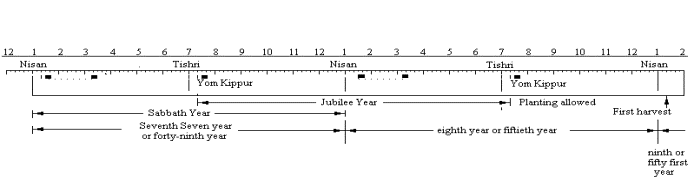
Figure 1: SABBATH AND
JUBILEE YEAR DIAGRAM
14 Abib / Nisan is Passover (Ex. 23:5). 15 to 21 Abib is the Feast of “Unleavened Bread” (Exodus 23:6).
Day after weekly Sabbath after Passover, “Omer” = barley sheaf (Exodus 23:11).
Fiftieth day 49 days after Omer—“Feast of Weeks” (Exodus 23:15-16).
1 Tishri “Feast of Trumpets” (Ex. 23:24). 10 Tishri Yom Kippur or “Day of Atonement” (Exodus 23:27).
15 to 21 Tishri “Feast of Booths or Tabernacles” (Exodus 23:34).
Jubilee years starts with the sounding of the Trumpet on 10 Tishri (Leviticus 25:9).
Sabbath year starts with the religious calendar on the 1st of Abib (implied Leviticus 25:1-6).
During the Sabbath and the Jubilee years gathering grain for food was allowed, but not reaping—the amount of grain collected is the issue. Normally the farmer would eat from grain stored before the Sabbath year, but if in need one could eat of the grain, but not harvest it.
Sequence and Time of Events
God, in Leviticus 26, enumerates blessings for obedience and levels of punishment for disobedience. In a more severe level of punishment, God promised to scatter the Israelites among the nations so that the land will receive its rest.[7] God kept that promise when He sent Judah into captivity in Babylon.[8] He forced the Israelites to let the land rest: "until the land has enjoyed her Sabbaths. As long as she lay desolate she kept Sabbath to fulfill seventy years."[9] The land rested for the rest years it had missed.[10] The rest years it had missed included both Sabbath and Jubilee years, because in both of these years the land must rest. "After the seventy years are completed at Babylon I will visit you and perform My good word toward you, and cause you to return to this place."[11] One can determine the period during which rests were missed if the seventy missed Sabbath rest years made up for all missed Sabbath years. If one knows the year of the start of the Babylonian captivity then one can fix the start of that period.
How many years of rest was the land given during the period of the kings? Scripture says, King Josiah in his eighteenth year kept the Passover better than any previous king,[12] This was about 624 BC shortly before the Babylonian captivity. If the people were not properly keeping the Passover, it is highly unlikely that they were keeping the Sabbath year rests, much less the Jubilee year rests. It is probable that during the time of the kings, the land was never voluntarily given a Sabbath year rest. Even David, one zealous to keep the law, broke it several times with serious consequences. When he moved the Ark of the Covenant the first time he did not have it carried by Levites, causing a man to die.[13] When he counted the people, he did not have them each pay the census tax, which brought on the people three days of plague.[14] There is one account of the land getting a rest. When God delivered Judah under King Hezekiah, God told him that the land would sufficiently produce for their needs, for the next two years they were not to plant or harvest.[15] This was exactly what the law required at a Jubilee year because it always followed a Sabbath year. This is therefore a reference to a combined Sabbath rest and Jubilee rest. Therefore, one can pinpoint this time in Hezekiah's life if the date of any Jubilee is known.
During the period of the kings of Israel and Judah there were exactly 70 Sabbath years missed, adding in the two rest years in the time of King Hezekiah there would be 72 rest years. From this, one can calculate that there were nine Jubilee periods paid for in these 72 rest years and the period to require this number of rests is 441 years.[16] The date of the first deportation of Judah into Babylon is 605 BC Therefore the start of the period would be 1046 BC, if there were no other breaks than the keeping of two rest years during Hezekiah reign. This point is very likely the start of Saul's reign. This is very compatible with conservative scholarship, which puts Saul's anointing between 1050 and 1025 BC[17] The Jubilee during Hezekiah's reign was in 704 BC. This places the start of the Babylonian Captivity immediately following a Jubilee year.
At the start of Jesus' public ministry, on the Sabbath the first day of the second Jewish month in AD 31 He visited the synagogue in Nazareth, His hometown. See Jesus’ two-year ministry. There, Jesus read from the scroll of Isaiah a proclamation of liberty and the acceptable year of the Lord.[18] Jesus announced a Jubilee year. The phrase "to proclaim liberty" is the term used in the law for the freedom brought by the Jubilee.[19] Jesus announced the Sabbath year preceding the Jubilee year. The Jubilee year follows the start of Sabbath year by six months. From 606 BC to AD 32 the Jubilee announced by Jesus, there were 637 years, exactly thirteen Jubilee periods.[20] We now have four known Jubilees (1047 BC, 704 BC, 606 BC and AD 32). To work back to the time of the first Jubilee, in the days of Joshua, we use the 479 years of 1 Kings 6:1. The year of entrance was commanded to be a Sabbath year.[21] Additionally because Joshua read the entire Law,[22] and only during the Sabbath year at the feast of Tabernacles (or Booths) was there a command to read the entire Law.[23] Nehemiah tells us that no one did it fully from Joshua's time until his time.[24] The second clue was the name of the place of Joshua's encampment, Succoths[25] meaning booths. The Law commanded the Israelites live in booths at the time of the reading of the Law. If the entrance occurred on a Sabbath year then the first possible Jubilee year would be 7½ years later. Because the Jubilee year starts the count, and the count was started after they planted, the Jubilee year cannot start until the 6 years of conquest are completed. Sabbath years start in the first month Nisan (Abib), Jubilee years start in the seventh month Tishri. See Sabbath and Jubilee year diagram on page 3.
Seven Jubilees before the anointing of Saul or 343 years brings us to 1391 BC 7½ years after Israel entered the Promised Land. Now the conquest of the land took six years, but afterwards it was necessary to map the land, divide it by lot, and conquer the remaining inhabitants before the people settled in the land. They entered on a Sabbath year, conquered for six years, divided the land and settled during the next two year and then they planted their first crop. The Jubilee year was to be counted from when the Israelites planted their first crop.[26] Planting was allowed in Tishri following the Jubilee year, this allowed a planted crop to be harvested immediately after the completion of two rest years.[27] The scheme would work as follows: The Red Sea crossing occurred on the day of the Omer offering (Sunday Nisan 17), in the year following a Jubilee year.[28] Forty-eight and one half years later the Israelites planted the first crop in the second half of the Jubilee year. Saul became king over Israel after the Jubilee 343 years later. Using this information, the duration from the Exodus to the start of the building of the temple was 479 years.[29]
To give a BC or AD date the Jubilee date is counted as starting in the following Gregorian year. Before Christ, the Jubilee started on the 10th day of the seventh month Tishri. The year 607 BC, will be referred to as 606 BC. The 10th of Tishri occurs about the beginning of October.
|
|||||
|
Date |
Elapsed years |
Factored years |
Description |
|
|
|
1439 BC |
0 |
|
The year before the Exodus. Moses at the Burning Bush. |
|
|
|
1390 BC |
49 |
1*49 |
The first planting in the promised land. |
|
|
|
1047 BC |
343 |
7*49 |
Year before the anointing of King Saul. |
|
|
|
704 BC |
343 |
7*49 |
The 15th year of Hezekiah. Sennacherib’s army destroyed. |
|
|
|
606 BC |
98 |
2*49 |
Year before Judah first went into captivity in Babylon. |
|
|
|
AD 32 |
637 |
13*49 |
Jesus announced the 'Acceptable year of the Lord'. |
|
|
One can surmise that Jubilee dating can be used before the Exodus even if at that time the land was not required to rest, because the Law had not yet been given. First, there were laws, from God, passed through the generations.[30] Second, the sojourn of the sons of Israel in Egypt (and Canaan LXX) was 430 years to the day.[31] This will be demonstrated later.
If a man had a Hebrew servant he was to let him go free after six years of labor and let him go free with an abundance of gifts.[32] Jacob served Laban a period of seven years for each of his wives and then six more years. He came out of servitude with abundance after the six years were completed. Why did the injunction of slavery extend to Hebrews rather than to just the Israelites? So that Jacob would be included. Now a Hebrew servant was required to be set free in the seventh year and he was not to be sent away empty handed.[33] God made certain that this happened. If the Exodus was on the Passover following the end of the Jubilee year then Israel returned from Padam Aram in the sixth year of a Sabbath cycle.[34]
The Jubilee
date immediately before the entrance into Egypt would be 12.5 years before the
Jacob and sons returned to Canaan.[35] This is 6 months after Jacob married Leah
and Rachael and a few months before Reuben was born. Therefore, Jacob married
about the start of a Sabbath year. Three Jubilees or 147 years earlier one year
after Abraham was circumcised in the spring Isaac was born. Abraham was
circumcised at the start of a Sabbath year and Isaac was born within the
succeeding Jubilee year. Both the birth
of Isaac and the sons of Israel were long delayed events. Why did they occur on a Jubilee year? <It had appeared to me that they were
born on the Omer following the Jubilee to match the time of the Exodus and the
Resurrection. Do further research.> < What was God’s purpose in delaying
these events until Jubilee years?>
The Pre-Abraham Period
Adam to the Flood
The view presented here of the period from Adam to the flood, assumes that there are no gaps in the record of Genesis 5 and 10. The length of time from Adam to Noah can be accurately found by adding the age of each man in the genealogy at the time of the birth of the son in the Massoretic text or Samaritan Pentateuch. While evaluating these sources, the author has required that two sources agree on the specific interval. The most questionable items are the age of Methuselah at the birth of his son, there being no agreement among the sources. And the age of Lamech at the birth of Noah because only using the data from the LXX allows Methuselah to die before the flood.
The New Testament records that Enoch was the seventh from Adam (Jude 14), which by the genealogy he is. The length of the life span after the son was born, plus the total length of the life, confirms that it is this son who was born and not that the man began to have children at this point and the successor was born some time later. A study of the manuscripts has the Massoretic text reading nearly always confirmed for the period from Adam to the flood by the Septuagint and/or the Samaritan Pentateuch. These sources never agree with each other for the numbers in Genesis 5 unless they agree with the Massoretic text. Where two or three witnesses agree a matter may be established.[37] If the MT date for Lamech is chosen there is a problem with the date of the Flood, because it appears that Methuselah dies after the start of the flood.
The Scripture indicates a one-year per generation adjustment to these numbers. The Flood started when Noah was 600 years old or in his 600th year. That is when Noah is 599 or in his 600th year, he is said to be 600.[38] For this to be so, they must have used a different method to count ages. It appears that Noah was counted as one year old in his first year. Today we would not say that he was one until he entered his second year. If this reasoning is correct then the actual ages of the men in Genesis 5, are all one year higher than stated. This subtracts ten years, one year per generation, from Adam to the Flood. We can surmise that Adam was born in year one rather than year zero because the counting starts at one. This is partially removed because a son would on average be born .5 years later that his father, but up to one year per generation could be added back.
All recent conservative scholars interpret the statement that Arphaxad was born two years after the flood when Shem was 100 years old[39] to mean that Shem was born when Noah was 602. Here it is taken to mean that he was born late in the year following the flood while Shem was still 100 (by the new reckoning). The Septuagint says in the second year after the flood rather than two years after the flood confirming this reasoning. It is of interest that the translation of Enoch occurred on near the twentieth Jubilee. Later we will find that at ten Jubilees intervals is often a major event. This brings then us to the date of the flood of 1652AM, about 4 years earlier than the standard Massoretic date of 1656 A.M. For reasons that will show up later there seems to be a 14-year discrepancy in the dating some time between the birth of Enoch and the birth of Isaac. I will include the error here, but more research is necessary. It could be related to the fact that the son is born on average .5 years later than the father. The time from Adam to the Flood is then 1666 years.
The Flood to Abraham
Most recent chronologists investigated used the patriarchal ages of the Massoretic text, which results in the shortest possible time between the flood and Abraham. The Samaritan Pentateuch is a very important witness to the text of the Old Testament and it provides a text of the chronologies of Genesis 5 and 11 that is independent of both the Septuagint and the Massoretic text.[40] The Septuagint and the Samaritan Pentateuch together agree on the years between generations. They are two witnesses, especially when correlated with other Biblical information, seems to provide a longer and better chronology than the Massoretic text. The chronology is better for the following reasons: Noah and Shem are considered righteous men it is therefore unlikely that they were involved in the sin at Babel. Abraham's fathers are said to have served other gods beyond the river.[41] If Noah and Shem were still alive at the time of Abraham then they would apparently be included in this sin of idolatry.[42] These problems disappear when using the Samaritan Pentateuch chronology, because the longer generations place the death of Noah and Shem before Babel. Luke 3:36 lists Cainan in the genealogy and there is no textual ground for eliminating this entry. Of these witnesses, only the Septuagint bears witness to this entry. It is likely that the entry for Cainan was dropped because the ages are the same as those for Selah. This is haplography. Wurthwein defines haplography as words or phrases found in immediate sequence and one omitted by error.[43] This can occur quite easily when a word or phrase matches a subsequent phrase. The addition of a name on the other hand would be a deliberate error.
If there is no reason to doubt the age of Noah at Shem's birth, then there is probably no reason to doubt the age of Terah at Abraham's birth, all manuscript evidence agrees that it was 70 years. One of the reasons driving the extending of Terah's age at Abraham's birth is to move the time of Babel earlier. If Terah's age at death is 145 as recorded in the Samaritan Pentateuch then there is no reason to doubt Stephen's statement in Acts 7:4 that Abram entered Canaan after the death of his father. The MT and the LXX record Terah’s age at death as 205 years. One group of scholars says Stephen made a mistake, but his mistake was accurately recorded, but Jesus said that the Spirit would guide the speech of those brought before a tribunal,[44] as Stephen was, and Stephen was said to be a man especially full of the Holy Spirit. In addition, Stephen could not make his point without including some of this information.[45] These facts make it likely that Stephen made accurate statements. There is no reason to ask why Abraham would have commented that he had passed his time (to bear children) at one hundred,[46] his father did not bear Abraham at 130, as generally proposed, but at seventy. We do not have to ask the question why did Terah, an idolater,[47] lived 30 years longer than his son, a righteous man, remembering that in principle righteousness adds to the life.[48]
A possible explanation for the variance of the Massoretic text has been proposed by Rehwinkel, "The word for one hundred was dropped by the copyist in the Massoretic text."[49] A second reason for variation is the numbers could be dropped inadvertently, but to add or change a number would take a deliberate manipulation of the text, which is less likely. For these reasons, the chronology here adopted follows the Samaritan Pentateuch and Septuagint for the genealogy of Genesis 11.
There are statements made in the Book of Jasher that tend to reveal it as a valuable source of history.
In Jasher 7:23 "And Cush the son of Ham, the son of Noah, took a wife in those days, in his old age, and she bare a son, and they called his name Nimrod." Nimrod is called a son of Cush in the scriptural record, but it separates Nimrod from his other sons. Here Jasher explains that Nimrod was born late in Cush's life. Nimrod was the leader of all the people at the tower of Babel. Therefore, if Jasher is correct, Ham was probably dead before the division of the tongues. In addition, Shem and Noah would be dead, helping us to avoid explaining how these righteous men were involved in the sin at the tower of Babel. If Ham lived roughly the same amount of time that Shem lived, then the division at Babel probably occurred somewhat more than 500 years after the end of the flood. This would place a gap in the genealogical record between Eber and his son (or descendent) Peleg if we accept the reading of the Massoretic text, but no gap with the Septuagint reading. Apparently Joktan was born first, because the record of his sons in Genesis 11 is given and nations are said to have descended from them, while Eber's son Peleg is listed without descendants. Many scholars believe that the age recorded there is the father's age at the time the oldest son was born. Second, Genesis 11 says, each nation descended from these seventy persons. Therefore, the tongues must have been divided among the people who represent those nations. Abraham, a descendent of Peleg, is called a Hebrew therefore it is likely that Joktan and his sons spoke their own language while Eber and Peleg spoke Hebrew. Abraham is called a Hebrew because of the language he spoke.
A Proposed BC Date for the Creation of Adam
Here some assumptions will be made that will be defended later. The Exodus occurred in 1438 BC, The length of the Egyptian sojourn was 400 years. From Abraham entering Canaan until Jacob journeyed to Egypt was 215 years. Abram was 75 year old when he journeyed to Canaan; therefore Abraham was born in 2128 BC.[51] From Adam to Abraham birth is 2738 years. Therefore the creation of Adam occurred in 4866 BC (2128 BC + 2738 years). Can Jubilee dating be used to extend back to the creation of Adam? God told the Moses when to celebrate the Jubilee, therefore God knowing the time of creation of Adam and specifying the Jubilee year could have made the times line up. The flood occurred in 1666AM (Anno Mundi) a Jubilee year (34*49). Isaiah 61:2 indicates Jubilee years can be either a time of God's favor or His vengeance or both. The above date for Adam's creation 4866 BC is evenly divisible by periods of 49 years from the already surmised Jubilee years. There is therefore no reason to doubt that Jubilee years extended back to Adam even if they were not celebrated in the same way.
|
||||||||||
|
|
Year |
Year |
age at |
years |
years |
year |
|
|
|
|
|
|
Born |
Born |
son's |
after |
lived |
died |
|
Supporting |
|
|
|
Name |
BC |
AM |
birth |
son's |
|
AM |
References |
Manuscripts |
|
|
|
|
|
|
|
birth |
|
|
|
|
|
|
|
Adam |
4869 |
0 |
129 |
800 |
929 |
929 |
Gen.5:3-5 |
SP & MT |
|
|
|
Seth |
4740 |
129 |
104 |
807 |
911 |
1040 |
Gen.5:6-8 |
SP & MT |
|
|
|
Enos |
4636 |
233 |
89 |
815 |
904 |
1137 |
Gen.5:9-11 |
SP & MT |
|
|
|
Cainan |
4547 |
322 |
69 |
840 |
909 |
1231 |
Gen.5:12-14 |
SP & MT |
|
|
|
Mahalaleel |
4478 |
391 |
64 |
830 |
894 |
1285 |
Gen.5:15-17 |
SP & MT |
|
|
|
Jared |
4414 |
455 |
161 |
800 |
961 |
1416 |
Gen.5:18-20 |
LXX & MT |
|
|
|
Enoch |
4253 |
616 |
64 |
300 |
364 |
980[52] |
Gen.5:21-24 |
SP & MT |
|
|
|
Methuselah |
4189 |
680 |
186 |
782 |
968 |
1648 |
Gen.5:25-27 |
LXX & MT |
|
|
|
Lamech |
4003 |
866 |
187 |
566 |
782 |
1648 |
Gen.5:28-31 |
LXX |
|
|
|
Noah |
3816 |
1053 |
499 |
450 |
949 |
1996 |
Gen.5:32 |
SP,MT,LXX |
|
|
|
Shem |
3317 |
1552 |
100 |
500 |
(600) |
2152 |
Gen.11:10-11 |
SP,MT,LXX |
|
|
|
Flood |
3217 |
1652 |
2 |
|
|
|
30*49=1470 |
31*49=1519 |
|
|
|
Flood |
3200 |
1666 |
2 |
|
|
|
Gen.6-8 |
|
|
|
|
Arphaxad |
3198 |
1654 |
135 |
403? |
(438) |
2106 |
Gen.11:12-13 |
SP & LXX |
|
|
|
Cainan |
3063 |
1789 |
130 |
330 |
(460) |
2263 |
Gen.11:13 |
LXX & Luke |
|
|
|
Shelah |
2933 |
1919 |
130 |
303 |
(433) |
2366 |
Gen.11:14-15 |
SP & LXX |
|
|
|
Eber |
2803 |
2049 |
134 |
270 |
(404) |
2467 |
Gen.11:16-17 |
SP & LXX |
|
|
|
Peleg |
2669 |
2183 |
130 |
109 |
(239) |
2436 |
Gen.11:18-19 |
SP & LXX |
|
|
|
Reu |
2539 |
2313 |
132 |
107 |
(239) |
2566 |
Gen.11:20-21 |
SP & LXX |
|
|
|
Serug |
2407 |
2445 |
130 |
100 |
(230) |
2689 |
Gen.11:22-23 |
SP & LXX |
|
|
|
Nahor |
2277 |
2575 |
79 |
69 |
(148) |
2737 |
Gen.11:24-25 |
SP & LXX |
|
|
|
Terah |
|
2654 |
70 |
(75) |
145 |
|
Gen.11:26,32 |
SP & Acts |
|
|
|
Abram |
2128 |
2724 |
100 |
75 |
175 |
2913 |
Gen.12:4 |
SP, MT, LXX |
|
|
|
|
|
|
|
|
|
|
|
|
|
|
|
Flood |
3200 |
1666 |
2 |
|
|
|
Gen.6-8 |
|
|
|
|
Arphaxad |
3198 |
1668 |
135 |
403? |
(438) |
2106 |
Gen.11:12-13 |
SP & LXX |
|
|
|
Cainan |
3063 |
1803 |
130 |
330 |
(460) |
2263 |
Gen.11:13 |
LXX & Luke |
|
|
|
Shelah |
2933 |
1933 |
130 |
303 |
(433) |
2366 |
Gen.11:14-15 |
SP & LXX |
|
|
|
Eber |
2803 |
2063 |
134 |
270 |
(404) |
2467 |
Gen.11:16-17 |
SP & LXX |
|
|
|
Peleg |
2669 |
2197 |
130 |
109 |
(239) |
2436 |
Gen.11:18-19 |
SP & LXX |
|
|
|
Reu |
2539 |
2327 |
132 |
107 |
(239) |
2566 |
Gen.11:20-21 |
SP & LXX |
|
|
|
Serug |
2407 |
2459 |
130 |
100 |
(230) |
2689 |
Gen.11:22-23 |
SP & LXX |
|
|
|
Nahor |
2277 |
2589 |
79 |
69 |
(148) |
2737 |
Gen.11:24-25 |
SP & LXX |
|
|
|
Terah |
|
|
70 |
|
(145) |
|
Gen.11:26,32 |
SP |
|
|
|
Terah |
2198 |
2668 |
70 |
75 |
(135) |
2803 |
Gen.11:26,32 |
|
|
|
|
Abram |
2128 |
2738 |
100 |
75 |
175 |
2913 |
Gen.12:4 |
|
|
|
|
||||||
|
Year AM |
Jubilee |
Year |
Standard |
Event Description |
|
|
|
0 |
0 |
4866 BC |
4004 BC |
Creation of Adam and Eve |
|
|
|
980 |
20 |
3886 BC |
|
Enoch translated |
|
|
|
1656 |
|
3210 BC |
2348 BC |
The Flood |
|
|
|
2842 |
58 |
2027 BC |
2065 BC |
Isaac Born |
|
|
|
2940 |
60 |
1929 BC |
|
Esau sold his birthright to Jacob & Famine |
|
|
|
2989 |
61 |
1880 BC |
1922 BC |
Jacob marries & Sons of Israel (Reuben) start arriving |
|
|
|
3038 |
62 |
1831 BC |
|
Just after the end of the seven years of famine. |
|
|
|
3430 |
70 |
1439 BC |
1146 BC |
Moses and the burning bush, the year before the Exodus. |
|
|
|
3479 |
71 |
1390 BC |
1399 BC |
The first planting in the promised land. |
|
|
|
3822 |
78 |
1047 BC |
1043 BC |
The anointing of King Saul. |
|
|
|
3920 |
80 |
949 BC |
958 BC |
The dedication of Solomon’s Temple |
|
|
|
4165 |
85 |
704 BC |
701 BC |
The 15th year of Hezekiah. |
|
|
|
4263 |
87 |
606 BC |
605 BC |
Judah first carried into Babylon. |
|
|
|
4410 |
90 |
459 BC |
452 BC |
Ezra restored people 6 years before Jerusalem restored |
|
|
|
4900 |
100 |
AD 32 |
28 or 31 |
Year after Jesus Announces 'Acceptable year of the Lord'. |
|
|
Many events are at 490 year[53] or 10 jubilee intervals.
The Patriarchal Period
The period from Abraham's entrance into the Promised Land until Jacob descended into Egypt is one of the least disputed intervals of time. Rowley succinctly outlines it as follows, "In Genesis 12:4 we read that Abram was seventy-five years old when he left Haran, and in Genesis 21:5 that he was one hundred years old when Isaac was born. Since Genesis 25:26 states that Isaac was sixty years old when Jacob was born, and Genesis 47:9 puts the age of Jacob at 130 when he went into Egypt, we have a total of 215 years from the migration of Abram to the Descent into Egypt."[54] The period from the entrance of Abraham into Canaan to the Egyptian sojourn is 215 as agreed among all scholars consulted and unchallenged here.
|
Table 4: ABRAHAM TO THE EXODUS |
|||||||||
|
Elap- |
Year |
Year |
|
|
|
|
|
|
|
|
|
sed |
AM |
BC |
Event |
Terah |
|
Abraham |
Sarah |
References |
|
|
|
|
|
2129 |
Abraham born |
70 |
|
0 |
- |
Gen.11:32;12:4;Acts 7:4 |
|
|
|
45 |
|
|
Terah dies |
145 |
|
(75) |
(65) |
Gen. 11:32 |
|
|
|
0 |
|
2054 |
Abram to Canaan |
|
Ishmael |
75 |
(65) |
Gen. 12:4 |
|
|
|
11 |
|
2040 |
Ishmael born |
Isaac |
0 |
86 |
(76) |
Gen. 16:16 |
|
|
|
13 |
|
2027* |
Circumcision |
|
13 |
99 |
(89) |
Gen. 17:1, 24 |
|
|
|
1 |
|
2026 |
Isaac born |
0 |
(14) |
100 |
90 |
Gen. 21:5;17:17 |
|
|
|
37 |
|
1989 |
Sarah dies |
(37) |
(51) |
(137) |
127 |
Gen. 23:1 |
|
|
|
3 |
|
1986 |
Isaac marries |
40 |
(54) |
(140) |
Jacob |
Gen. 24:67; 25:19 |
|
|
|
20 |
|
1966 |
Jacob & Esau born |
60 |
(74) |
(160) |
0 |
Gen. 25:26 |
|
|
|
15 |
|
1951 |
Abraham dies |
(75) |
(89) |
175 |
15 |
Gen. 25:7 |
|
|
|
24 |
|
1929* |
Sold birthright |
[99] |
[113] |
|
[39] |
Gen. 25:31 |
|
|
|
1 |
|
1928 |
Esau marries |
(100) |
(114) |
|
40 |
Gen. 26:34 |
|
|
|
23 |
|
1905 |
Ishmael dies |
(123) |
137 |
|
(63) |
Gen. 25:17 |
|
|
|
17 |
|
1888 |
Jacob's flight |
(140) |
|
Joseph |
(80) |
Gen. 28:5 |
|
|
|
7 |
|
1881 |
Jacob marries |
(147) |
|
|
(87) |
Gen. 29:20-30 |
|
|
|
1 |
|
1880* |
Rueben born |
(148) |
|
|
(88) |
Gen. 29: 31-32 |
|
|
|
5 |
|
1876 |
Joseph born |
(154) |
|
0 |
(94) |
Gen. 30:25; 31:41 |
|
|
|
8 |
3001 |
1868 |
Jacob enters Canaan |
(160) |
|
(8) |
(100) |
Gen. 31:38, 41 Ex. 12:41 |
|
|
|
2 |
|
1862 |
Joseph sold |
(169) |
|
17 |
(109) |
Gen. 37:2-28 |
|
|
|
11 |
|
1851 |
Isaac dies |
180 |
|
(28) |
(120) |
Gen. 35:28 |
|
|
|
2 |
|
1849 |
Joseph made Vizier |
|
|
30 |
(122) |
Gen. 41:46 |
|
|
|
8 |
2972 |
1838 |
Jacob to Egypt |
|
|
(39) |
130 |
Gen. 46:1;47:9 |
|
|
|
6 |
2978 |
1831 |
End of famine |
|
|
(44) |
(135) |
|
|
|
|
12 |
|
1819 |
Jacob dies |
|
|
(56) |
147 |
Genesis 47:28 |
|
|
|
54 |
|
1765 |
Joseph dies |
|
|
110 |
|
Genesis 50:26 |
|
|
|
326 |
3430 |
1439* |
Burning bush |
|
|
|
|
Ex. 3:2-3 |
|
|
|
1 |
3431 |
1438 |
Exodus |
|
|
|
|
Ex. 12:40-41 |
|
|
* Marks a Jubilee year () Calculated numbers [] Estimated numbers
 Bible mentions
three circumcisions that were not done on the eighth day, all occurred at God's
specific instruction. Abraham and his
entire household were circumcised just before the feast of unleavened bread in
Abraham's 99th year. Moses'
son was circumcised shortly before the start of the plagues on Egypt. The Israelites born in the wilderness were
circumcised about the 11th of Nisan as they entered the Promised
Land.[55] The circumcisions that can be dated occurred
just before the middle of Nisan. Moses'
son could be the same. This would allow
us to estimate the approximate date of the burning bush as the start of Nisan
one-year before the Exodus.
Bible mentions
three circumcisions that were not done on the eighth day, all occurred at God's
specific instruction. Abraham and his
entire household were circumcised just before the feast of unleavened bread in
Abraham's 99th year. Moses'
son was circumcised shortly before the start of the plagues on Egypt. The Israelites born in the wilderness were
circumcised about the 11th of Nisan as they entered the Promised
Land.[55] The circumcisions that can be dated occurred
just before the middle of Nisan. Moses'
son could be the same. This would allow
us to estimate the approximate date of the burning bush as the start of Nisan
one-year before the Exodus.
Discerning the date of Jacob’s marriage is somewhat more difficult, Jacob came to Egypt when he was 130 years old near the end of the second year of famine. Joseph became vizier at age 30 about 8 years earlier. Joseph was born near the end of the seven-year period following Jacob’s marriage to Leah and Rachael. So Jacob got married when he was about 130 - (38+6) = 86 years old.
The Egyptian Sojourn
There are three main opinions for the length of the Egyptian sojourn: 430 years, 400 years, and 215 years.[56] Exodus 12:40-41 in the Massoretic text supports the 430-year view where the sojourn in Egypt is said to be 430 years to the day. It interprets the 430 years of Galatians 3:17 to commence with the promise to Isaac, the seed of Abraham, as he entered Egypt.[57] This view holds that the genealogies of the period were often abbreviated. This view sees the 400-year period as the period of bondage to Egypt.
The Septuagint and Samaritan Pentateuch add a phrase missing in the Massoretic text to Exodus 12:40-41, Now the sojourn of the sons of Israel in the land of Canaan and in the land of Egypt was 430 years. At the end of the 430 years, to the very day, all Yahweh's divisions left Egypt. The 215-year period takes the reading of the Septuagint, but assumes that the 430-year period includes the 215-year period of the patriarchs in the Promised Land. The 400 years[58] is timed from the weaning of Isaac at age five.[59]
It is here proposed that the length from the return of Israel to Canaan after the sojourn in Padam Aram to the Exodus is 430 years. These witnesses allow 430 years to include the time sons of Israel are in Canaan and Egypt. The sons of Israel arrived in Canaan when Jacob returned from Padam Aram. Galatians 3:16-17 430 years from promise to Abraham and his seed to the Exodus. This "promise to his seed" was made to Jacob just before crossing Jabbok when he wrestled with God and his name was changed to Israel.[60] After Israel and his sons had spent 30 years in Canaan, they went down to Egypt for 400 years as promised to Abraham. It also agrees with Acts 13:19-20. Because the “about 450” conflicts with 1 Kings 6:1 and Judges 11:26 it must refer to the period in Egypt for this to be true. The about 450 years is broken down as follows: 400 years in Egypt, 40 years wandering, and 8½ years to full division of property. Any reading of Exodus 12:40-41 disproves the 215 year sojourn in Egypt because it says the period of time is for the sons of Israel, because until about 40 years before the Egyptian sojourn there were no "sons of Israel.” Jacob's name was first changed to Israel while he was returning from Padam Aram and preparing to confront his brother Esau. This is also the same time that his sons first entered Canaan. Before that, his sons had always lived in Padam Aram. Both the promise made to Abraham, and the recap by Achior[61], make it clear that the time in Egypt was 400 years.
The promise to return in the fourth generation was made to Abraham. His promised son was born when he was 100 years old. Four of Abraham's generations of promise are precisely 400 years. The word for generation means 1) a man's entire life span, 2) more commonly from a man's birth to the birth of his offspring, 3) a period or age of time.[62] However, in the fourth generation, they shall come out.[63] If a generation is the period of the average life span then it is 400/4=100 years. This seems unlikely to be the average time between the birth of the father and the birth of his son remembering Abraham's comment of his age at the time of the promise of the birth of Isaac that he was beyond child bearing age and his wife was barren. The 400th year was just starting when Israel came out of Egypt.
This cannot be 400 years of oppression because the oppression does not start until later, at least after the death of Joseph. The oppression does not get severe until the time of the birth of Moses. Aaron, Moses' older brother, was not threatened with death. Joseph was a leader until his death and it supports the twelve sons of Israel dying before the time of oppression. Then a pharaoh arose who did not know Joseph.[64] This occurred after Jacob died because Joseph promised to provide for his brothers and their children at that time.[65] In addition, it says Joseph was embalmed implying that he retained his status until his death.[66]
Acts 13:19-20 further comments, Scripture says He "gave" them their land as an inheritance[67] rather than he "promised" them their land as an inheritance suggests that the time referred to ends when they actually receive their land. Luke here uses the prefix kata before the verb. This intensifies the meaning of "to receive as an inheritance" to "fully receive as an inheritance," meaning they settled in their inheritance. The reason this passage is given a "D" rating (meaning no good reading or a great uncertainty in the reading) is not that the best text cannot be found but rather that the best text apparently disagrees with 1 Kings 6:1. Farrar reminds us that in the decision about which of two readings to select the rule is to choose the more difficult reading.[68] This period fits when applied to the period in Egypt and conflicts with the length of the period of the Judges.
400 Year Duration of the Egyptian Sojourn Shown from Genealogies
The sojourn in Egypt was 400 years, this promise was to be slaves in a country not their own made to Abraham. From the following, it can be discerned that we do not have a complete genealogy of Moses (Kohath, Amram, and Moses) during the sojourn in Egypt. Kohath lived 133 years,[69] and Kohath was alive when Israel went into Egypt.[70] Amram lived 137 years.[71] There is at least one missing generation here. Because God said they would come out in the fourth generation, there would only be three otherwise. Moses was eighty at the time of the Exodus, at that time, Amram’s father, Kohath, had 8600 male descendants, and it appears that about twenty-five percent are descendants of Amram.[72] The maximum time without adding extra generations is 350 (133+137+80) years between these men. If the four generations spoken of to Abraham are taken as the total then we can find the average number of children per family during the exile. Seventy people went down to Egypt: Jacob, twelve sons, fifty-one grandsons, four great-grandsons, a daughter and two granddaughters.[73] If there were five generations, with and average of fourteen children per family, there would not have been sufficient people to have 600,000 men at the time of the Exodus. If even fourteen children per generation are not enough, it is unlikely that five generations was enough. Archer has proposed that the sons needing redemption are the first born sons, born since leaving Egypt.[74] This lessens the need for such large families. In addition, four generations would be a short period to span 400 years.
A passage that indicates a longer Egyptian sojourn is 1 Chronicles 7:20-27, the genealogy from Ephraim to Joshua. Ephraim, Joseph's second child, was born in the seven-year period before the start of the seven years of famine.[75] The generations are Ephraim, Shuthelah, Bered, Tahath, Eladah, Tahath, Zabad, and Zhuthelah.[76] If each man were 23 when his son was born there would be 161 years between the birth of Ephraim and the Birth of Zhuthelah, seven generations later. Ezer and Elead were killed in battle with men of Gath. If these were sons, there would be an additional generation here. Ephraim was still alive at that point and had an additional son Beriah. From Beriah to Joshua, the genealogy has nine more generations. The series of generations are Beriah¾Ephraim's new son, then Repheph, Resheph, Telah, Tahan, Laadan, Ammihud, Elishama, Nun, and Joshua. If each man were 23 when his son was born there would be 207 more years for a total of 368 years from the birth of Ephraim to the birth of Joshua. If Joshua were thirty at the Exodus, this would bring the total to 398 years, very close to the 400 years of the sojourn in Egypt. The minimum time between Jacob's entrance into Egypt and the Exodus would be about 330 years, if the average generation were only 18 years. If this is compared with the often-proposed Egyptian sojourn of 215 years, it makes the 215-year period obviously short because the average generation would have to be less than 12 years.
Joseph lived to be 110 and Joseph saw Ephraim's children to the third generation,[77] Joseph stood before pharaoh when he was 30 years old[78] therefore within 80 years (110-30) the third generation was born. Both Ephraim and Manasseh were born before Joseph was thirty-seven. Therefore there are between seventy and 78 years for "children" of Bered's generation (the third) to be born but to not yet have any children of Tahath's generation (the fourth) yet born. It also mentions the children being brought up on Joseph's knees, this might imply that they were counted as the next generation.[79] Ephraim and Manasseh were counted as Israel's sons while on Israel's knees.[80] Ephraim was second born; therefore, he was probably not born until at least two years after Joseph rose to power. Because there was a promise that they would come out in the fourth generation it is interesting that Ephraim, a member of the first generation, should have a child (Beriah) so late in life, about 180 years old, thus allowing the generation from father to son to be greatly extended over its normal time.[81] If this was repeated then some of the members of the fourth generation would still be alive. Might not men in the days of Moses' birth, mourn over the loss of their descendants who were cast in the river and therefore seek to bear new children? This also explains how the population could increase so greatly, where the promise was that they would come out a great nation in the fourth generation.
While over a period of 400 years with the population doubling every 25 years there would be more than 4.5 million Israelites. However, there is only about 2.5 million. Why? First, the pharaoh attempted to kill the male children. Secondly, the Book of Jasher records that when Ephraim was 180 years old (the age his grandfather died); forty thousand of his descendants were killed in a battle with the Philistines at Gath. The battle would reduce the enormous population and it would explain Ephraim's mourning.[82] He was not mourning for two lost descendants, but for a multitude of descendants. Josephus mentions that they were not led by the "Way of the Philistines" because they were hated because of a quarrel of old.[83] Further, it greatly extends the time from between generations and if Abraham's seed were counted in Ephraim, it would be specifically the number of generations Ephraim had in Egypt until the Exodus.[84]
The Judges Period
There are two Scriptural witnesses as to the overall length of the judges period. Jephthah mentions that Israel occupied Heshbon 300 years. This was in a diplomatic setting, the 300 years cannot refer to a period with gaps or it would make no sense and be challenged immediately. Heshbon was captured in the 39th year after the Exodus. In 1 Kings 6:1 we are told that the temple foundation was laid in the 480th year after the Exodus.[85] These witnesses agree on the length of the period of the Judges. The 480th years of 1 Kings 6:1 is 479 years plus two months. The dating of the reign of Solomon is from the month of Tishri, assession year reckoning was used and the months were numbered from Nisan even when the year was counted from Tishri. <<Small diagram>> The months are numbered from Nisan but the years are counted from Tishri, therefore what is called the 2nd month we today would call the 8th month. This also leads us to the conclusion that the completion of the temple occurred just before a Jubilee, the completion of the temple articles and the gathering of the people to celebrate the dedication probably marks the beginning of the Jubilee. This dating can be discovered by carefully evaluating 1 Kings 6:37-38[86] where the building took 7 years but started in the 4th year 2nd month and finished in the 11th year 8th month.
"If all the terms of service performed by the various judges are added end to end, along with the stated periods of oppression, they form a consecutive total of approximately 410 years." "But the long date of 480 years (1 Ki. 6:1) seems to allow for only 292 years between the judgeship of Othniel and that of Eli."[87] The key ingredient in determining the length of the early judges period (up to the time of Jephthah) is the four periods that the "land had rest." It is the contention of the author that during the period when the Judge judged, that oppression by a foreign power was not permitted.[88] Nevertheless, the land could have rest before the judge came into office, a kind of peace while ruled by a foreign power. The judge merely finished out the period of 40 or 80 years of rest. This is the only way that the chronology of the judges period can be worked out for the following reasons.
Joshua ruled for a significant period, probably forty years. “Joshua first appears . . ., as the leader of Israel in the Battle of the 'Amalekites at Rephidim, . . ., as Moses' attendant (cf. Ex. 24:13, 32:17, 33:11), being described in 33:11 by the Hebrew word na`ar which can hardly denote more than a youth approaching man's estate.”[89] If we combine these¾a warrior leader, and very young man—we may picture him about 30 years old at the time of the Exodus. Because he was among those counted at the first census, he was at least twenty at that time.[90] The word "from" used in 'from his youth' suggests that he had now ceased to be a youth. It is likely that he had turned thirty by the time he was sent to spy out the land.[91] It is therefore likely that between the time that the law was given and the time he went to spy, Joshua turned 30 years old, the approximate age when a person would cease being a na'ar. This helps us divide Joshua's life into three parts. Thirty years in Egypt, 40 years wandering in the wilderness and 40 years as a leader over Israel.[92] The term "a long time" is used several times in the book of Joshua. It is first used of the length of the period of the war of conquest, a period of about 6 years.[93] It is used a second time of the period of rest, after the conquest,[94] but taken by scholars to mean about 10 years. Six years of war would be a long time to be at war, but a man of 110 would not be likely to consider 10 years to be a long period of peace. The final use of a long time is used to refer to the period spent in the wilderness[95] a period of 40 years.
The next point of contention has to do with the "age" at death of the elders who outlived Joshua. A study of the scholars shows that all have the period of the elders ending within 71 years of the Exodus.[96] The elders who were boys at the time of the Exodus would then universally have had to die before they turned 80. Looking at the ages of those whose life spans are stated, it is found that Aaron lived to be 123, Miriam 120+, Moses lived to be 120, and Joshua lived to be 110.[97] Caleb was still vigorous at age 85.[98] Ehud judged for 80 years[99] and therefore could hardly have been less than 100 years. Othniel born before the entrance judged Israel for 40 years[100] starting 8 years after all the elders had died; he therefore was probably at least 100 years old. Eli died at age 98.[101] Now it is apparent the maximum life span of man was growing shorter during the Egyptian sojourn, for instance the recorded life span of Israel was 147, Levi was 137, Kohath was 133, Amram was 137, Moses 120,[102] etc.
Joshua was considered old after 6 years of conflict; he was at this time nearly 80 years old. He is called old from the standpoint of leading an army into battle not in terms of being nearly ready to die. This is much as we would consider a professional basketball player old at 40, not ready to die, too old to compete professionally. Moses was 80 when he led Israel through the Red Sea, but Joshua led the army into battle.
In Psalm 90:10 Moses says man's life span is 70 or 80 years. This does not mean that everyone dies by 80, unless he is referring to those who died in the wilderness. Now it does say that all those who were counted in the first census in the wilderness had died by the time of the second census 38 years later.[103] But this does not imply that the life span of the Israelites was normally that short but rather that those men were judged for their disbelief and their lives were therefore shortened. This judgment suggests that their normal life span was greater otherwise, they would not be dying young. If these ages are representative then many of the elders should have lived to be at least 100 and some of them should have lived to be at least 110. If this is the case then a boy who was ten years old when he witnessed the parting of the sea and lived to be age 110 would then be one of the last of the elders, and would not have died until more than 50 years after the Conquest was completed. The lives of the elders were probably cut short at this point to allow for the punishment of the Mesopotamian oppression. This compares with 61 to 71 years after the Exodus for the conservative position.
The conquest of Canaan starting in years 41 from the Jubilee meant that the land rested during the 8 years of the conquest, mapping, division by lot, and conquest by individual tribes. After this, the land was cultivated—therefore the land started at a place where it had received the rest that it required.
|
|||||||||||||||||
|
Person/Event |
Unger[104] |
Whitcomb[105] |
Wood [106] |
Rutherford |
Proposed |
|
|||||||||||
|
Exodus |
1441 |
40 |
1445 |
40 |
1446 |
40 |
|
40 |
1439 |
40 |
|
||||||
|
Entrance |
1401 |
41 |
1405 |
34 |
1406 |
31 |
1413 |
25 |
1399 |
49 |
|
||||||
|
Mesopotamian |
1360 |
6 |
1381 |
8 |
1375 |
8 |
1388 |
8 |
1350 |
8 |
|
||||||
|
Othniel |
1354 |
40 |
1373 |
39 |
1367 |
40 |
1380 |
40 |
1342 |
32 |
|
||||||
|
Moabites |
1314 |
18 |
1334 |
18 |
1327 |
18 |
1340 |
18 |
1310 |
18 |
|
||||||
|
Ehud |
1296 |
81 |
1316 |
79 |
1309 |
80 |
1322 |
80 |
1292 |
62 |
|
||||||
|
Canaanites |
1215 |
15 |
1257 |
*20 |
1229 |
20 |
|
*20 |
1230 |
20 |
|
||||||
|
Deborah |
1200 |
45 |
1237 |
39 |
1209 |
40 |
1242 |
40 |
1210 |
20 |
|
||||||
|
Midianites |
1155 |
5 |
1198 |
7 |
1169 |
7 |
-1202 |
|
1190 |
7 |
|
||||||
|
Gideon |
1150 |
40 |
1191 |
40 |
1162 |
40 |
1202 |
40 |
1183 |
40 |
|
||||||
|
Abimelech |
1110 |
5 |
1151 |
3 |
1122 |
3 |
1162 |
3 |
1143 |
3 |
|
||||||
|
Tola |
wanting |
|
1149 |
23 |
1119 |
23 |
1159 |
23 |
1140 |
23 |
|
||||||
|
Jair |
wanting |
|
1126 |
21 |
1118 |
22 |
1136 |
22 |
1142 |
*22 |
|
||||||
|
Ammonites |
wanting |
|
1105 |
18 |
1096 |
18 |
|
|
1117 |
18 |
|
||||||
|
Jephthah |
1105 |
6 |
1087 |
6 |
1078 |
6 |
1114 |
6 |
1099 |
6 |
|
||||||
|
Ibzan |
wanting |
|
1081 |
6 |
|
|
|
|
|
|
|
||||||
|
Elon |
wanting |
|
1075 |
+10 |
|
|
|
|
|
|
|
||||||
|
Abdon |
wanting |
|
1065 |
*7 |
|
|
|
|
|
|
|
||||||
|
300 yrs Heshbon |
|
305 |
|
359 |
|
328 |
|
301 |
|
300 |
|
||||||
|
Philistines |
1099 |
50+ |
1087 |
*40 |
1095 |
40 |
|
|
1145 |
40 |
|
||||||
|
Samson |
1085 |
20 |
1069 |
20 |
1075 |
20 |
|
|
1105 |
20 |
|
||||||
|
Samuel |
1035 |
10 |
1067 |
*24 |
1075 |
25 |
1069 |
11 |
1185 |
37 |
|
||||||
|
Saul |
1025 |
15 |
1043 |
32 |
1050 |
40 |
1058 |
20 |
1047 |
40 |
|
||||||
*overlap
The next problem with the chronology is the inability to squeeze the judges period into the chronology the way it is normally done (See Table 1: Comparison of Conservative Views of the Judges Period, page 18), because of the violence it does to the text. Scripture says that when Yahweh raised up judges for Israel, Yahweh was with the judge, and saved Israel from the hand of their enemies all the days of the judge.[107] An enemy might arise and might attempt to oppress Israel, but the enemy would be defeated. So the times of oppression do not overlap the judgeship of any person raised up by Yahweh to be judge. Later, God says, "I will deliver you no more,"[108] suggesting that now a time of oppression might overlap a judge because God is no longer defending Israel from oppression.
Each of the periods until Tola has the previous judge dying, the people turning from God, God bringing on a period of oppression, and finally God raising up a new judge who delivers Israel for the rest of his life and the land having rest. This sequence does not allow for overlaps. There is a transition in the Judges period, as the people grow more wicked where overlap between judge and oppression is allowed. For instance as is often done, the last 20 years of Ehud's judgeship are overlapped with the 20 years of the Canaanite oppression, in order to synchronize the time period with the strong and weak control periods of Egypt and to reduce by 20 years the period of the judges.[109] (See Table 2 Comparison of Conservative Views of the Judges Period, page 18). If Ehud's rest was not a real rest period why does the text mention Shamgar who rescued the Israelites from the Philistines. The conclusion is that Ehud was still able to Judge, but not able to lead an army into battle. Also if this oppression overlapped a period of peace the actual period of peace would then have been an uninterrupted 120 years because the 80 years would be immediately followed by 40 years of peace under Deborah.[110]
Jephthah states that Israel had dwelt in Aroer and Heshbon 300 years before the Ammonites wanted to take them back.[111] Jephthah is speaking shortly after the period of the judges during which we can have no overlap. If we add up the known lengths of time it is found that from the entrance until the time of Jephthah is at least 357 years. Apparently Jephthah knew something we do not or he would have said more than 300 years had passed. It is the thesis held here that Jephthah knew that the length of the period of Israelite control was exactly 300 years. But he knew to leave out the years of oppression by foreign powers because after the initial contact these were periods of peace (except for the Midianites who caused disruption year by year). For instance the Amorite territory was from the Arnon to the Jabbok[112] was the territory that had been dwelt in for 300 years was the area that nearly every oppressor of the Israel would have had to control first before the area to the west of the Jordan could be controlled. The first oppressors from Mesopotamia would pass directly through this area. The next oppressors the Moabites with the Ammonites[113] would have come through this area to get to Jericho. The other two oppressions by the Canaanites and the Midianites would have had this area on their flank unless it was subdued. Therefore, the Israelites could not have controlled this area unchallenged for 300 years. Therefore, Israel continued to control that territory, but sometimes as a vassal state.
An additional complication shows up from Jephthah until King Saul. In the remaining 58 years, we need to place the Ammonite oppression, Jephthah, Ibzan, Elon, Samson, Abadon, Eli, Samuel, and 40 years of Philistine oppression.[114]
Archaeologists particularly try to shorten the period of the Judges for reasons of supposed links with Egypt. This can be refuted additionally by the genealogy of Samuel the prophet.[115] He was descended from Israel, Levi, Kohath,[116] Izhar,[117] Korah,[118] Ebiasaph,[119] Assir, Tahath, Zaphaniah, Azariah, Joel, Elkanah, Amasai, Mahath, Elkanah, Zupu, Toah, Eliel, Jeroham, Elkanah, Samuel. From this it can be discerned that there were at least sixteen generations from the conquest until the time of Saul (364 years / 16 generations = 23 years per generation). These generations show a significant passage of time. For a refutation of the archaeological argument for shortening this period, see Bible Archaeology.
The period at the end of the judges has to account for Eli and Samuel. (1) Neither Eli nor Samuel is called a judge in the book of Judges. (2) At least the end of Eli's life overlapped the Philistine oppression. (3) Samuel was a boy when he is told of Eli's imminent demise (1 Samuel 3). (4) Twenty years later Samuel calls the people to turn to Yahweh and leads them to victory over the Philistines.[120] (5) Throughout Samuel's lifetime, Yahweh's hand was against the Philistines.[121] (6) Samuel was an old man when he appointed his sons as judges and older yet then he anointed Saul as king.[122] He could hardly be less than sixty when he anointed Saul. It follows that there must have been at least 30 years of peace following the oppression of the Philistines, and that oppression lasted 40 years. (7) From this, it can be concluded that from the end of Jair's judgeship to the beginning of Saul's reign there can be no fewer than 70 years. (8) 300 years minus 18 years had passed between the capture of the land of the Amorites according to Jephthah after Jair ruled. (10) 39 years passed between the Exodus and the capture of the Amorite land. (11) The total of these times (39+300+70-18) is 391 leaving no more than 88 years for the reigns of Saul and David and 4 years of Solomon's reign because of the figure in 1 Kings 6:1.
The history of Eli's family
during the period of Samuel and Saul requires a considerable lapse of
time. The death of Eli synchronizes
with the death of his son Phinehas in the battle of Aphek (1 Sa. 4). Since Phinehas was still an able-bodied man,
his son Ahitub must have been a young man at most at that date. Yet according to (1 Sa. 14:3), it is
Ahitub's son Ahijah (Apparently = Ahimelech of Chr. 22:11) who is priest
in the early or middle part of Saul's reign; and at the slaughter of the
priests of Nob, Abiathar, the son of Ahimelech and grandson of Ahitub,
escapes to David carrying the Ephod with him, and is old enough to exercise the
priestly office on David's behalf by manipulation of the sacred lot.[123]
(Priests could only serve from age 30 years to age 50).
Rebuttal to the Conservative Position:
Whitcomb in his chronology of the judges has Samuel born during the Ammonite oppression near the start of Eli's judgeship. About 20 years later the Philistine oppression starts coincident with the judgeship of Jephthah. Twenty years later in the middle of the Philistine oppression Samson, Samuel, and Abdon begin their judgeships about the same time. Just four years before Saul starts to reign for 32 years Philistine oppression ends. This chronology flies in the teeth of the statement that Yahweh was against the Philistines all the life of Samuel. Whitcomb has the Philistine oppression starting when Samuel is about 18 and ending when he is 58. How can the Philistines be oppressing Israel while Yahweh is against them?
|
||||||
|
Year |
Start |
End |
Elapsed |
Event |
|
|
|
A.M. |
BC |
BC |
Time |
@FINISH ADJUST DOWN ONE YEAR |
|
|
|
3430 |
1439* |
1138 |
1 |
Moses and the Burning Bush |
|
|
|
3431 |
1438 |
1399 |
39 |
Exodus Moses (Levi) census and wandering |
|
|
|
|
1399 |
1398 |
1 |
Conquering Transjordan & Moses' speeches |
|
|
|
3471 |
1398 |
1393 |
6 |
Entrance into promised land |
|
|
|
|
1393 |
1392 |
2 |
Land divided--tribes battle individually |
|
|
|
3479 |
1390* |
1390 |
31 |
Israelites settle in land--Joshua judges |
|
|
|
|
1350 |
1350* |
19 |
Elders who saw God's mighty work rule |
|
|
|
|
1351 |
1343 |
8 |
Mesopotamian oppression |
|
|
|
|
1342* |
1312 |
32 |
Othniel judge (Judah) |
|
|
|
|
1310 |
1373 |
18 |
Moabite oppression |
|
|
|
|
1372* |
1293 |
62 |
Ehud and Shamgar judge (Benjamin) |
|
|
|
|
1291 |
1273 |
20 |
Canaanite oppression |
|
|
|
|
1272 |
1233 |
20 |
Deborah judge (Ephraim?) |
|
|
|
|
1232 |
1224 |
7 |
Midianite oppression |
|
|
|
|
1225 |
1184 |
40 |
Gideon judge (Abiezrite?) |
|
|
|
|
1185 |
1181 |
3 |
Abimelech king (Abiezrite?) |
|
|
|
|
1182 |
1144 |
24 |
Tola [23] & Jair [22] overlap (Issachar) (Manasseh) |
|
|
|
|
1145* |
1126 |
18 |
Ammonite oppression-overlap with Philistine |
|
|
|
|
1127 |
1120 |
6 |
Jephthah judge (Manasseh) |
|
|
|
|
1121 |
1113 |
7 |
Ibzan judge (Judah) |
|
|
|
|
1114 |
1103 |
10 |
Elon judge (Zebulun) |
|
|
|
|
1104 |
1095 |
8 |
Abdon judge (Ephraim?) |
|
|
|
|
1145* |
1106 |
40 |
Philistine oppression-overlap with Ammonite |
|
|
|
|
1105 |
1084 |
20 |
Samson judge (Dan) |
|
|
|
|
1085 |
1048 |
37 |
Samuel judge (Levi) |
|
|
|
|
1047* |
1006 |
42(41) |
Saul king (Benjamin) |
|
|
|
|
1006 |
999 |
7.5 |
David king in Hebron (Judah) |
|
|
|
|
997 |
0965 |
33 |
Year after jubilee David king in Jerusalem |
|
|
|
@ |
0973 |
0965 |
8 |
Solomon king (overlap with David) |
|
|
|
|
0964 |
0933 |
32 |
Solomon king (sole over Israel) |
|
|
|
@ |
0959 |
0959 |
4 |
Temple started (1 Ki. 6:1 480th after Exodus) |
|
|
|
|
0949* |
0949 |
9.5 |
Temple dedicated (1 Kings 8) |
|
|
|
4037 |
0931 |
|
|
Division of the kingdom |
|
|
* Jubilee year (Tribe)-tribe to which a judge or king belonged.
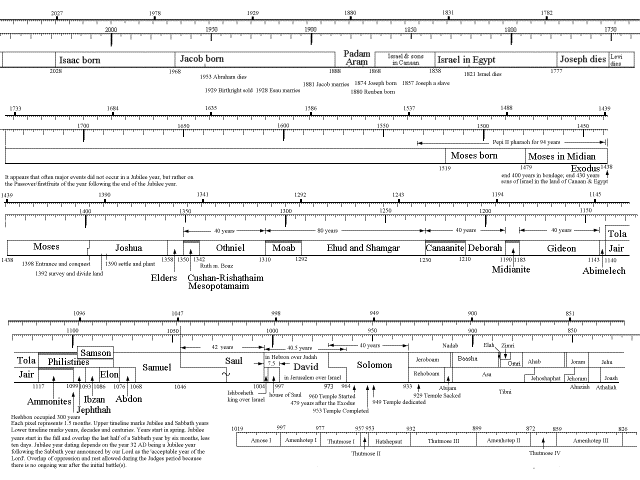
Figure 2:
A Chronological Chart of the Patriarchs and Judges
Conservative Views of the Kings Period
The period of the kings lasted from the anointing of Saul until Jerusalem and the Temple were destroyed and Zedekiah, king of Judah, went into captivity in Babylon. This period has three sections: the united kingdom—Israel, then the divided kingdom—Israel and Judah, finally the kingdom of Judah alone. The united kingdom lasted for about 113 years. The divided kingdom followed. Most conservative scholars agree with Edwin R. Thiele's chronology for this period. Thiele has proposed a method which recognizes accession and non-accession year reckoning, years starting in the month of Nisan or the month of Tishri, and overlapping reigns and coregencies which answer most chronological problems during this period. He has linked this chronology with the Assyrian kings lists to produce a time of 931/30 BC for the division of the kingdom. The time of Hezekiah fifteenth year is 702/01 BC. The time for the start of the Babylonian captivity was 604 BC. The time for the destruction of Jerusalem and the Temple of 586 BC.
Thiele says, “The single greatest cause for misunderstandings concerning the chronological data in the Books of Kings has been the failure, both in ancient and modern times, to recognize the employment of what may be termed "dual dating" in connection with the regnal data in certain coregencies and overlapping reigns.”[124] “Whenever a king came to the throne in either nation, a synchronism of that year in terms of the year of reign of the ruler of the other nation was entered in the record. When a reign came to its end, a notation was made of the number of years the ruler had been on the throne. Each nation made these notations in terms of the system of reckoning that was currently used in its own nation, whether accession- or nonaccession-year reckoning.”[125] Thiele found that the kingdom of Judah started counting the reign of a king from Tishri, the seventh month.[126] He found that the kingdom of Israel after the division started counting the reign of a king from Nisan, the first month.[127] Judah used an accession-year system that is a method of counting the years of a king's reign where the partial first year was not counted. The kingdom Israel used the non-accession-year reckoning so the first partial year is counted as the first year of the kings reign. The total of the lengths of reigns in Judah is the total period of time while in Israel one year per king must be subtracted from the total period of time. The months are numbered from Nisan regardless of from which month the kings reign was reckoned.[128] Each country used its own method of reckoning dates for the lengths of reign and synchronisms of the kings of the other country.[129] The king would often crown his son as a coregent if the situation warranted. In these areas, with the exception of the dates the author agrees with Thiele.
Thiele later linked his chronology to the Assyrian chronology, which noted a dateable eclipse. This link and the later adjustments he made to accommodate this linkage are in the main rejected. The author is certain that there was a change in the stable progression of the solar system at the time of the going back of the shadow of the sun in the days of Hezekiah. Thiele's dateable eclipse is earlier than this point and therefore is not precisely datable by astronomical methods. Thiele also links his dates to Ptolemy’s Canon. These early dates are rejected because Ptolemy calculated the eclipse data then fit the rulers into the expected pattern. Because the pattern had a discontinuity, it cannot be considered accurate.
In the period of the judges, the people ask for a king instead of God and God tells Samuel to listen to the people because they have rejected him as king. Before this God did not allow other kings to usurp his position.[130] Jeroboam was told that he would serve other kings.[131] Therefore just after the start of the divided kingdom, Israel suddenly comes under the control of Egypt and we never read about that yoke being cast off. This drastically affects synchronisms with Egypt, See Bible Archaeology for the historical situation.
The Old Testament record is missing two words right at the spot where King Saul's age when he became king and the length of his reign is stated.[132] The length of Saul's reign is stated in Acts 13:21 as forty years and in Josephus as forty years.[133] David at the beginning of his reign ruled over Judah only. A son of Saul, Ish-bosheth, claimed the throne of Israel reigned for two years, making Maharaim on the east of the Jordan his capital.[134] Ishbosheth’s age (also called Eshbaal) provides a check on the duration of Saul's reign. Ishbosheth was forty when he began to reign (2 Sam. 2:10). Scripture lists Saul's sons and daughters at the time of his accession in 1 Samuel 14:49. Ishbosheth is not listed among them, showing that he had not yet been born. As Ishbosheth was 40 years old at Saul's death, this means that Saul reigned for at least 40 years. When he died, others from the house of Saul ruled including Abner.[135] When Abner died David was anointed king over all Israel[136] and reigned over the whole nation 33 years after having ruled over Judah for seven years and six months.[137] The lengths of the reigns of Saul, David and Solomon are all given as forty years.[138] It appears that the main reasons for shortening Saul's reign are to prevent the overlap of his kingship with the judgeship of Samson; to allow Samuel to grow old enough to need to appoint his sons as judges; and to shorten the period of the monarchy before the Temple was built so that the maximum number of years is available for the judges period. There can be no overlap between the reign of Saul and David because although David was anointed king while Saul was still alive David was not counted as king until he was ruling in Hebron. Saul reigned at least 40 years; there is therefore no reason to doubt Paul's statement that he reigned 40 years although this may be an approximation. The author believes that Saul reigned in parts of 42 different years, but less than 41 years total. There can be a certain amount of overlap between Solomon and David because Solomon was twice anointed as king while David is still alive.[139] The Temple was started some time after David's death, but not more than 4 years later. Because David is told he cannot build the Temple, but he prepared for the building of the Temple. The Temple is first built in the fourth year of Solomon's reign. Thiele states that Israel used the Tishri reckoning during Solomon's reign, which Judah continued to use, but Israel did not, after the separation of the kingdoms.[140] Saul probably dies at Passover because of the reference to unleavened bread on the night before his death. It is therefore highly likely that Israel used the accession year reckoning starting in the month of Tishri that Judah continued to use after the division. This would mean that the forty-year periods were at least forty years but less than forty-one years. The reign of Saul started in Tishri 1047 BC and ended in Nisan 1008 BC. The reign of David started in Nisan 1008 BC and ended in Tishri 968 BC. The reign of Solomon started in 973 BC overlapping three years with his father David. The overlap is shown in the fact that David had Solomon anointed some time before his death and he then began to prepare to build the Temple. The second month of the fourth year may refer to the second month of the first year after David died, but the fourth year of his reign as king, but it appears that it refers to the fourth year of Solomon’s sole rule. Solomon's reign ended in 932 BC.
Problems with the Conservative View of the Kings Period
The first problem is that Thiele fails to take into account earth-moving events recorded in the Bible. The sun stood still in the sky for Joshua and the sun's shadow moved backwards for Hezekiah. These events mark changes in the stable progression of solar and stellar events making eclipses unreliable clocks for the fixing of the time of events in the history of the ancient world. Because many do not see any change in the stable progression of the earth in either the days of Joshua or Hezekiah, they consider the miracles in these events, to be the miraculous refraction of the sun's rays.
Thiele says, the sequence in 2 Kings 15:23-38 and the synchronisms in 2 Kings 17:1 and 18:1, 9, 10 must have been corrupted during transmission because they have the kingdom of Israel continuing until the sixth year of Hezekiah or about fifteen years after the Assyrian records say it was destroyed.[141] Thiele is saying that the last 20 years or so of the synchronisms between Israel and Judah were made up, because Israel was destroyed 20 years earlier. Which is more reliable the interpretation of the Assyrian records or the received Scriptural witness.
Scripture says, Israel, as a people, was to be destroyed within 65 years of the days of Ahaz.[142] According To Thiele, they were carried off into captivity in the days of Hezekiah only a few years later. It is therefore difficult to understand why the period would have been placed at 65 years unless something else happened after they were carried into captivity.
Relegating certain passages to late editorial corruption is not an acceptable way to deal with the problems of the synchronism of 2 Kings 17. Critics must revise this entire chapter because it does not fit into their conceived pattern of history.
The Kings Period
The work done by Thiele is a valuable aid for the reconstruction of the chronology of this period nevertheless, Thiele in his earlier attempts to work out the chronology of the Hebrew kings, came closer to the chronology proposed here. At that time, he states that he had only two problem verses in reconciling the scripture with itself.
In the pattern as it then
existed there was a harmonious arrangement of the reigns according to the data
of Kings for both the synchronisms and the length of reign except for the two
synchronisms of 2 Kings 15:32 and 16:1, for the accessions of Jotham and
Ahaz. On the pattern as it then stood,
Hoshea came to the throne in a year which was both the twentieth year of Jotham
and the twelfth year of Ahaz, according to the synchronisms of 2 Kings 15:30
and 17:1, and Hezekiah began to reign in the third year of Hoshea, in harmony
with 2 Kings 18:1. Jotham, however, on
that pattern came to the throne in the same year as did Pekah in Israel, the
year of Azariah's death, and not in Pekah's second year as called for by the
synchronism of 2 Kings 15:32, and Ahaz began his reign in the eighth instead of
the seventeenth year of Pekah as called for by the synchronism of 2 Kings 16:1.[143]
Later, Thiele attempted to link his chronology to the Assyrian chronology, in doing this he was forced to compromise the Scripture to synchronize Israelite and Assyrian chronologies.
A passage (Ezekiel 4) would appear to indicate that the length of the Israelite nation was at least 390 years. Because this is not considered possible by the interpreters, this author has not seen a convincing interpretation of the passage. Israel had accumulated 390 years of punishment and Judah had accumulated an additional 40 years of punishment. First, we presume the punishment was on the people of Israel rather than the nation of Israel. Second and we presume that they could continue to be punished until they ceased to be a people. If Israel existed for 336 years then during that period they would accumulate 54 years of missed Sabbath rests to pay for. These two numbers add up to 390 the years of punishment paid for by Ezekiel. If we add the 40 years paid for by Judah there are 11 years unaccounted for in the 441 years between Saul and the first wave of the captivity. This could be the time allowed by the keeping of the Sabbath and Jubilee rests by Hezekiah after the siege of Sennacherib.
When the 70 years are finished, I will punish the king of Babylon.[144] Could the end of the 70 years correspond to the time of the writing on the wall especially since Darius the Mede took over after Balshazar died[145]? Moreover, the first year of Darius is the same year Daniel had his vision and understood the number of the 70 years.[146] There are three different 70 years periods, one for Jerusalem, one for Babylon and one for the land.
|
|||||||
|
Year |
Year |
|
|
|
Important |
|
|
|
A.M. |
BC |
Judah |
Israel |
Assyria |
Events |
|
|
|
|
1047 |
Saul |
|
|
|
|
|
|
|
1008 |
David |
|
|
|
|
|
|
|
972 |
Solomon |
|
|
|
|
|
|
|
932 |
Rehoboam |
Jeroboam I |
|
Temple |
|
|
|
|
914 |
Abijam |
|
|
Sacking |
|
|
|
|
912 |
Asa |
|
|
|
|
|
|
|
911 |
|
Nadab |
|
|
|
|
|
|
910 |
|
Baasha |
|
|
|
|
|
|
887 |
|
Elah |
|
|
|
|
|
|
886 |
|
Zimri/Tibni |
|
|
|
|
|
|
881 |
|
Omri |
Ashurnasipal |
|
|
|
|
|
875 |
|
Ahab |
Shalmaneser II |
|
|
|
|
|
871 |
Jehoshaphat |
|
|
|
|
|
|
|
854 |
|
Ahaziah |
|
|
|
|
|
|
853 |
|
Joram |
|
|
|
|
|
|
849 |
Jehoram |
|
|
|
|
|
|
|
842 |
Ahaziah |
Jehu |
|
|
|
|
|
|
842 |
Athaliah |
|
|
|
|
|
|
|
836 |
Joash |
|
ShamsiAdadV |
|
|
|
|
|
815 |
|
Jehoahaz |
Adadnirari III |
|
|
|
|
|
799 |
|
Jehoash |
|
|
|
|
|
|
797 |
Amaziah |
|
ShalmaneserIV |
|
|
|
|
|
783 |
|
Jeroboam II |
Ashurdan III |
|
|
|
|
|
768 |
Azariah |
|
|
|
|
|
|
|
754 |
|
Zechariah |
Ashurnarari |
|
|
|
|
|
753? |
|
Shallum |
|
|
|
|
|
|
753? |
|
Menahem |
|
|
|
|
|
|
741 |
Jotham |
Pekahiah |
|
|
|
|
|
|
741 |
|
|
|
|
|
|
|
|
733 |
Ahaz |
Pekah |
Shalmaneser V |
|
|
|
|
|
717 |
Hezekiah |
Hoshea |
Sennacherib |
Israel into |
|
|
|
|
688 |
Manasseh |
|
|
Captivity |
|
|
|
|
644 |
Amon |
|
|
|
|
|
|
|
642 |
Josiah |
|
|
|
|
|
|
|
610 |
Jehoahaz |
|
|
|
|
|
|
|
610 |
Jehoiakim |
|
|
Judah into |
|
|
|
|
606 |
Jehoiachin |
|
|
Captivity |
|
|
|
|
598 |
Zedekiah |
|
|
|
|
|
|
|
570 |
|
|
|
|
|
|
|
|
|
|
|
|
|
|
|
Hezekiah’s great revival in his first year began at the very start of a Sabbath year. His 8th and 15th, 22nd, and 29th or last year were all Sabbath years—his reign was framed by Sabbath years and centered on the Jubilee year. Also, Thiele position that the kingdom of Israel was already destroyed by the time of Hezekiah’s reign is wrong because Hezekiah called men from both Israel and Judah to his revival Passover in his first year. 2 Kings 18:10 Samaria was captured in Hezekiah’s 6th year, just before the Sabbath year.
Babylonian Captivity to Christ Period
There is general agreement on the chronology of the period from the Babylonian captivity to Christ. For this period, we are more dependent on secular sources for the dates, but we are into an era where eclipse data is valid and useful. The date of the end of the Babylonian captivity here conservatives fall into two camps; the first takes the statement of the Scripture that the period lasted 70 years[147] at face value so it must be exact and complete. The second group studying the records of the Babylonians during this period come to the conclusion[148] that the actual period of captivity lasted about 69 years and they then allow one years to expire before the Temple was started to be rebuilt by Ezra to complete out the 70 years. A variation on this is that the 69 years began just before the end of one year and ended just after the start of the year therefore it is counted as 70 years because it included part of 70 different years. The author takes this final view.
The information on this period is obtained from two sources the first is Ptolemy's Almagest or Canon which details the starting and ending dates of the main world rulers from the period before the captivity into Christian times. Because Ptolemy includes eclipse data along with his canon of rulers, his is considered a very authoritative source for this period.
Dating from the end of the captivity until the death of Christ. A key date is the decree to restore and rebuild Jerusalem, the birth of Jesus the Messiah and the date of his crucifixion. The method of determining this period is to take the implied length from Daniel 9:24-26. In this passage 69 sevens (of years) or 483 years to pass between the time of the decree to restore and rebuild Jerusalem and the time the Messiah, the anointed one comes. This decree is generally agreed to be the document issued by Artaxerxes authorizing Nehemiah to rebuild Jerusalem.[149] The common dating for the issuance of this decree is 444 or 445 BC. If normal years are used for the calculation then Christ died in AD 40. Because this does not meet any normal calculations for the date of Jesus' death, years of 360 days are postulated as prophetic years and then the date of Jesus' death is brought down to a more acceptable AD 33.[150] This often cited proposal that the period from the proclamation to Nehemiah until the time of the Messiah is 483 periods of 360 day years is rejected because Genesis 1:14 says that the sun, moon, and stars are for years, signs and seasons. The sun governs the length of the year. The length of the year had been 360 days until Hezekiah’s reign, and then there was a change in the stable progression of the earth around the sun. By the end of the Babylonian captivity, the length of the year had probably settled into our current 365.242 days per year. This pushes the date of Nehemiah's decree some seven years earlier to 451 BC. All eclipse data before the time of Hezekiah is rejected for dating events before that time because there were major changes in the length of the year.
Ezra is normally dated as having journeyed from Babylon to Jerusalem in the spring of 458 BC.[151] Ezra and the Israelites start their journey on the first day of the year, the first day of the year after the Jubilee year 459 BC. During that year, he caused the people to get rid of their foreign wives, completing just as the year ended. Ezra as the leader of the returnees is assumed old at this time. Nehemiah is said to return in the twentieth year of Artaxerxes.[152] Artaxerxes was a coregent with his father for a period of years before his father Xerxes died. Because Nehemiah, the cupbearer, was personally close to Artaxerxes, it is likely that he dated his reign from the time when Artaxerxes was made coregent.[153] In the seventh month after Nehemiah returned the Law was read, indicating a Sabbath year. The law only needs to be read to the people in the seventh month of the Sabbath year.[154] Note: for Nehemiah the 20th year of Artaxerxes does not start in Nisan compare Nehemiah 1:1 and 2:1. Also note, Nisan is month number one although it is not the first month in the year for the reign of kings, confirming Thiele. Because Ezra dates the reign of Artaxerxes in the seventh year of his reign (Ezra 7:8) and Nehemiah dates from the twentieth year of Artaxerxes (Neh. 1:1, 2:1) these events are assumed to be separated by 13 years. In Nisan 453 BC five years later Artaxerxes issues the proclamation to restore and rebuild Jerusalem[155] and Nehemiah comes to Jerusalem. The walls of Jerusalem are rebuilt and in the seventh month, the Law is read. In 31 AD, 483 years later, Jesus announces the acceptable year of the Lord fulfilling Daniel 9:26. Jesus quoting from Isaiah 61:1 is announcing, in their hearing that the Lords Anointed One has come, Messiah is revealed. The final seven-year period is still future. It is of interest that the 490 years of Daniel 9:24 do not start on a Jubilee but rather on a Sabbath year the end of the 483 years is a Sabbath year that includes the start of the Jubilee years. Seven years remain to fulfil Daniel 9:27. It is also of interest that 483 years of 365.242-day years is nearly identical to 490 * 360 day years. This revelation of Jesus was the Messiah is about two years earlier than the normal time Jesus is assumed to be revealed on Palm Sunday.
|<------20th year------>| The period referred to in Nehemiah 2:1
473BC 465BC 458BC 453BC 444BC
|8 years|7 years|5 years|9 years|
|<----->|<----->|<----->|<----->|
| | | | Normal dating for Nehemiah’s return
| | | Nehemiah returns and the walls are rebuilt, in Artaxerxes’ twentieth year
| | | This is a Sabbath year.
| | Ezra and the people return, foreign wives and children put away.
| | This is the year following a Jubilee year.
|
|
| Artaxerxes sole king of Medo-Persia
The traditional date for the deliverance of the Jews in the days of Queen Ester is Adar 14, 509 BC very close to the Jubilee year preceding Ezra’s return to Jerusalem 459 BC.[156] The time of the Maccabean revolt and the cleansing of the temple are traditionally dated in 165BC. The jubilee date near this event is 165 BC. Whether these events are exactly linked is unknown at this time without more study.
After the Babylonian captivity, one can find evidence that the Jews kept the Sabbath years—the Israelites had learned their lesson. For instance 1 Maccabees 6:48-54 some Jews were keeping a Sabbath rest year. Clearly, the Jews were not keeping the rests at the right time. For instance, while in a city under siege, the defenders are starved out after only a short period, because it was a “sabbatical year and they could not harvest.” The problem is that God promises to have the land produce enough for two years, allowing resistance to a much longer siege. Second, Yahweh promised that if they kept these laws they would be dwelling in security, being under siege does not sound like a particularly high level of security.
But if the priests interpreted the Law such that the Sabbath year was said to occur at such and such a time then it would be a Sabbath year because the successor to Moses—the priests in Ezra's time were the authoritative interpreters of the Law. The person(s) who sat in Moses seat interpret the law in a legally binding way.[157]
Josephus [158]
In Daniel 9:25 the 483 years end with the Messiah the Prince. In Luke 4:18 Jesus reading from Isaiah 61:1 Yahweh has anointed me—Jesus is claiming to be the Messiah—anointed by the Lord—a new time period starts. “This day, in your hearing this has been fulfilled.”
This brings us to the final area of problem that is the dates of Jesus' birth, ministry and death. A separate article has been written on this topic see Dionysius Exiguus. The conclusion from that paper is that Jesus was born within a few weeks of the transition between BC and AD. Jesus’ public ministry lasted just over two years rather than the common teaching that it lasted 3.5 years. Jesus died on Passover AD 33.
There is much apparently contradictory evidence. The first set places the death of Jesus in Nisan AD 30; the second set of evidence places His death in Nisan AD 33. The year AD 30 and 33 are fixed as the only choices. Only in these years was a Friday Passover/crucifixion astronomically possible. The alternate days of the week for the crucifixion as without serious merit.
Sidebar God prompting the church to establish the standard dating system (Anno Domini, Gregorian Calendar) used worldwide, influenced the accurate selection of the date chosen for the birth of our LORD. It could be that Jesus’ birth / incarnation was December 25, 1 BC. This would best fit the scenario that Jesus was about 30 when he began his public ministry in AD 31 and died in AD 33. If there were a year 0, it would be 1 BC.
The Length of Jesus Ministry
See http://www.tckillian/bible/Jesus2yearMinistry.htm Jesus’ public ministry primarily occurred during the Sabbath and Jubilee years pair. The year of His resurrection occurred on the immediately following the first harvest to the very day, the first in three years.
|
||||
|
Year |
Year |
Event or King |
|
|
|
A.M. |
BC |
|
|
|
|
4259 |
610 |
Jehoahaz |
|
|
|
4259 |
610 |
Jehoiakim |
|
|
|
4263 |
605 |
1st Captivity—Babylonian captivity starts |
|
|
|
4263 |
605 |
Jehoiachin |
|
|
|
4270 |
598 |
Zedekiah |
|
|
|
4284 |
586 |
Jerusalem destroyed |
|
|
|
|
562 |
Jehoiachin released/Evil-Merodach king |
|
|
|
|
538 |
End of captivity |
|
|
|
|
536 |
Temple starts under Zerubbal |
|
|
|
|
520 |
Temple resumes |
|
|
|
|
516 |
Temple finished |
|
|
|
4410 |
459 |
Ezra returns with many people |
|
|
|
4416 |
453 |
Jerusalem rebuilt under Nehemiah |
|
|
|
|
166 |
Temple Desecrated |
|
|
|
|
165 |
Temple restored |
|
|
|
|
16 |
Herod rebuilds temple (46 years before AD31) |
|
|
|
4867 |
1 BC |
Jesus Born |
|
|
|
|
AD 1 |
Herod dies |
|
|
|
4899 |
31 |
Jesus announces Sabbath year + Jubilee |
|
|
|
4900 |
32 |
Jubilee year during Jesus’ ministry |
|
|
|
4901 |
33 |
Jesus dies, rises & the Church is born |
|
|
The next sections I know that there are many who will not be able to receive them. Here we transition from the Israelite period to the Church Age.